
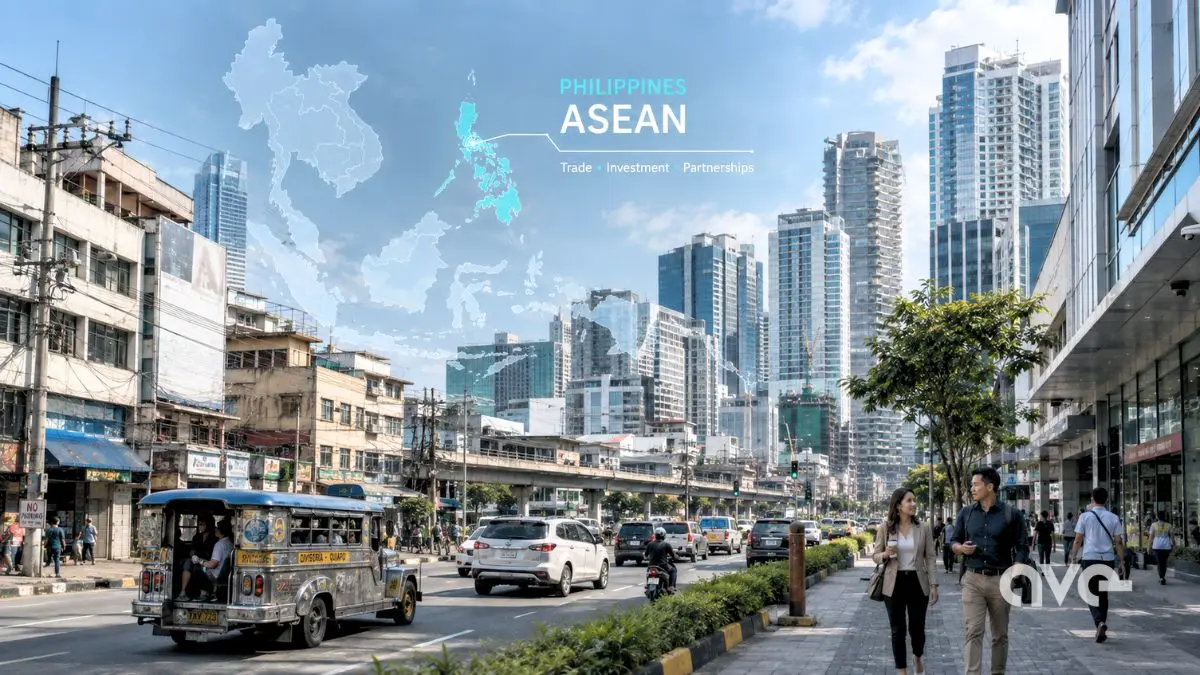
- The Philippines recently promoted its trade, investment, and tourism opportunities to international business leaders at the 2026 International Asian American Business Expo in California.
- Philippine representatives positioned the country as a strategic gateway for businesses seeking access to the wider ASEAN market.
- ASEAN economic integration gives Philippine businesses and investors access to a regional market of more than 600 million people.
- Regional trade agreements, investment flows, and improving connectivity strengthen the Philippines’ potential role within international business networks.
- For foreign companies, the Philippines can provide both a domestic growth market and a base for developing partnerships across Southeast Asia.
Philippines Promotes International Business Opportunities
The Philippines continues to position itself as a destination for international business as government and industry representatives promote stronger connections with investors, entrepreneurs, and overseas business communities.
At the 3rd International Asian American Business Expo held in Torrance, California, the Philippine Consulate General in Los Angeles joined representatives from six other countries and approximately 80 businesses for discussions covering international trade, investment, market access, entrepreneurship, and economic cooperation.
During the Consuls General Roundtable, Philippine Consul General Adelio Angelito S. Cruz presented the Philippines as a strategic gateway to ASEAN.
The message reflects a broader opportunity behind Philippine trade and investment opportunities. International companies considering the country are not necessarily entering an isolated domestic market. They are also establishing a presence within one of the world’s increasingly integrated economic regions.
The Philippines Within the ASEAN Market
ASEAN economic integration has created stronger connections between the markets of Southeast Asia.
Through the ASEAN Economic Community, member economies continue working toward greater movement of goods, services, investment, and skilled labor while reducing barriers to regional business activity. According to the Philippine Department of Trade and Industry, the integrated market gives Philippine businesses access to more than 600 million consumers.
For international businesses, this regional position complements opportunities within the Philippine market itself. Investment activity extends across established economic centers such as CALABARZON, the Clark-Subic corridor, Cebu, and Davao, where manufacturing, logistics, technology, services, tourism, and other industries have developed around different regional strengths. A Philippine presence can therefore form part of a broader Southeast Asian strategy, although market access still depends on the requirements of individual sectors, trade arrangements, and supply chains.
Trade Agreements and Investment Policies Support Market Entry
Regional participation connects the Philippines to economic relationships extending beyond ASEAN itself. The country participates in ASEAN trade agreements with several major economies and is a member of the Regional Comprehensive Economic Partnership, or RCEP, which connects 15 Asia-Pacific economies.
Market access is only one part of the investment environment. Within the Philippines, programs such as the Strategic Investment Priority Plan, CREATE MORE, and the Green Lane for Strategic Investments provide frameworks for investment incentives and project facilitation in qualified sectors. These mechanisms can influence how companies evaluate the cost, timing, and long-term viability of establishing operations in the country.
For businesses assessing Philippine trade and investment opportunities, the decision therefore extends beyond regional geography. Workforce, infrastructure, incentives, supply chains, operating conditions, and access to suitable locations all contribute to where and how an international company establishes its Philippine presence.
Where Investment Is Taking Place in the Philippines
Recent investment activity demonstrates how international and domestic capital is translating into projects across different parts of the country. By August 2026, the Philippine Economic Zone Authority had approved ₱216.46 billion in investments across 196 projects, with manufacturing accounting for the largest share of approved investment. Ecozone development, IT-BPM, logistics, tourism, and utilities were also represented.
These investments are geographically distributed rather than concentrated entirely in Metro Manila. Of the projects approved by PEZA from January through August, 161 were located in Luzon, 23 in the Visayas, and 12 in Mindanao. Established and emerging investment locations include the industrial economies of CALABARZON, the manufacturing and logistics network surrounding Clark and Subic, and regional business centers such as Cebu and Davao.
The opportunities available to an international company therefore vary considerably by location and industry. A manufacturer evaluating an economic zone in Southern or Central Luzon faces different requirements from a technology company establishing operations in Cebu or a tourism-related investor exploring a regional destination. Understanding these local conditions is an important part of converting broad interest in the Philippines into a viable investment strategy.
International Networks Can Create Business Connections
The International Asian American Business Expo also demonstrates the role that professional and institutional networks can play in attracting international investment.
The two-day event brought together entrepreneurs, businesses, government representatives, consulates, and exhibitors from multiple countries. Rather than investment promotion occurring only through formal government channels, these environments create opportunities for direct conversations between companies and potential partners.
For businesses exploring an unfamiliar market, those relationships can be especially important.
Local partners can provide knowledge of regulations, business practices, property, construction, suppliers, customers, and market conditions that may be difficult to understand from outside the country.
Cross-border investment therefore depends not only on identifying economic opportunities but also on building the networks capable of turning those opportunities into viable projects.
The Philippines as a Platform for Regional Growth
The Philippines’ position within ASEAN is becoming increasingly relevant as the region pursues deeper economic integration.
The ASEAN Economic Community Strategic Plan 2026–2030 aims to strengthen regional competitiveness, innovation, resilience, sustainability, and economic integration. The Philippines, as ASEAN Chair in 2026, also has an opportunity to contribute to the implementation of the region’s longer-term economic agenda.
For investors, this creates a useful way of viewing the Philippine market.
The opportunity is not simply to enter the Philippines. It is to understand how the country can participate in a broader Southeast Asian business strategy through investment, partnerships, trade, and regional connectivity.
As Philippine institutions continue promoting the country internationally, successful investment will depend on connecting global capital and expertise with credible local partners, viable projects, and a clear understanding of the market.
The country’s ASEAN membership connects it to an increasingly integrated Southeast Asian economy, including regional trade, investment, services, and business networks.
The event included discussions on international trade, investment, market access, entrepreneurship, tourism, and broader economic cooperation.
Businesses can benefit from regional market access, investment flows, trade agreements, improved connectivity, and opportunities to develop partnerships across Southeast Asia.
Local partners can help international businesses understand regulations, operating conditions, property markets, suppliers, customers, and other factors involved in establishing and expanding Philippine operations.
AVE Group Inc. connects international investors, businesses, and strategic partners with opportunities in the Philippine market. For organizations exploring investment, market entry, business development, or potential partnerships in the Philippines, contact AVE Group Inc. to discuss opportunities and local connections aligned with your objectives.